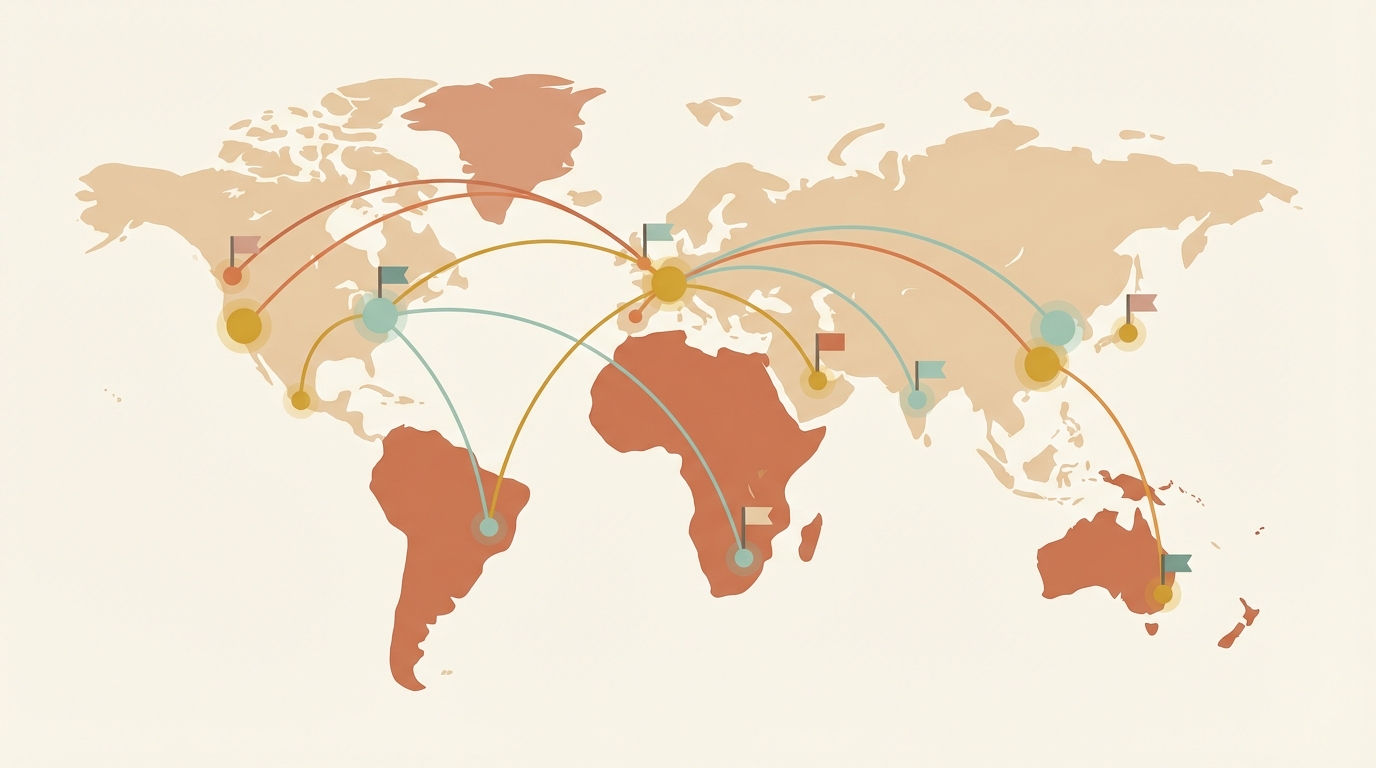
While everyone watches OpenAI and Anthropic release new models, governments are asking a different question: who controls the AI our economy runs on?
More and more, the answer is: we want to control it ourselves.
What sovereign AI means
Countries want to run AI on their own terms. Data, models, and infrastructure stay under local control. The government decides where workloads run, who accesses them, and how they're governed.
In practice:
- Data stays in-country
- Models run on local infrastructure
- Compute is controllable and consistent
This is already driving billions in infrastructure investment.
Emerging markets are moving fastest
The US and China lead model development. But for AI deployment and governance, emerging markets are ahead.
India
India's AI strategy comes from "Atmanirbhar Bharat" (Self-Reliant India). The target: a trillion-dollar AI economy by 2035.
The Digital Personal Data Protection Act (DPDP) sets data residency rules. The IndiaAI Mission is buying 10,000+ GPUs for sovereign compute.
If you're serving Indian customers or chasing government contracts, your AI workloads need to run on compliant infrastructure.
Brazil
Brazil treats AI sovereignty as part of a Global South strategy. LGPD (Lei Geral de Proteção de Dados) already enforces strict data protection. Bill 2338/2023 pushes toward comprehensive AI regulation.
The government is investing in domestic compute, anchored by the Santos Dumont supercomputer, to reduce dependence on foreign cloud providers.
For enterprises in Brazil, AI compliance is a market access requirement.
Indonesia
Indonesia and Malaysia have enacted data localization laws for financial services, public sector, and healthcare. This isn't future policy. It's current law affecting real deployments.
ASEAN broadly is moving toward sovereignty requirements for any AI workload touching local data.
The compliance gap
Most AI infrastructure wasn't built for this.
Major cloud providers run centralized data centers in the US and Europe. Running inference through them means your prompts and outputs traverse foreign infrastructure.
For a chatbot startup, maybe that's fine. For a bank, hospital, or government agency in an emerging market, it's increasingly illegal.
The numbers:
- LGPD violations in Brazil: fines up to 2% of revenue
- DPDP non-compliance in India: penalties up to ₹250 crore (~$30M)
- Indonesia data localization: applies to all critical sector data
Ignoring this limits your addressable market.
What this means
Sovereign AI isn't nationalism. It's pragmatic governance of infrastructure that matters.
For global AI deployment:
Multi-region inference becomes mandatory. You can't route everything through US-WEST-2 and call it compliant.
Provider selection matters. Not every inference provider can guarantee data residency.
Compliance is a feature. The platforms that win will be those that make sovereignty easy, not an afterthought.
What comes next
France announced a €109 billion AI plan. Saudi Arabia is building massive in-country compute. India's IndiaAI Mission is deploying thousands of GPUs.
For companies building with AI: either build for sovereignty now, or retrofit later at higher cost.
The good news is that inference routing makes compliance achievable without massive infrastructure investment. You don't need data centers everywhere. You need smart routing to compliant compute wherever your users are.
Countries pushing for sovereign AI aren't trying to slow adoption. They want to benefit from it on their own terms. Meet them there.